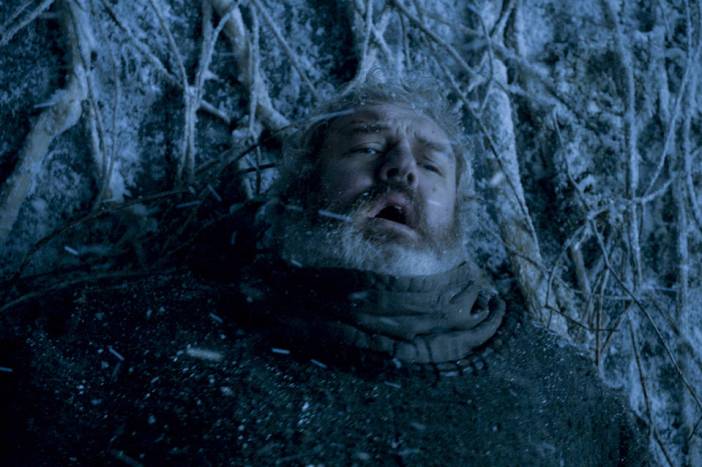
 Season 6 episode 5 ‘The Door’ showed the beginning, the end, and the destiny of one of the series favourite lesser characters, Hodor. It was finally revealed why Hodor says “Hodor”, only three episodes after his real name was revealed as Wylis in season 6 episode 2 ‘Home’ (Walder in the books). While to some viewers it was not obvious why Bran’s mistake warging into young Hodor was the incident that destroyed his mind, and to others it was the scene where the series “jumped the shark”, it was a landmark moment and sent the web and social media into meltdown. While some people might have thought that having someone whose name was a corruption of “hold the door” seems ridiculous, there was a real historical person whose name meant just that. They too sacrificed themselves to hold the door shut in an attempt to save a member of a noble house from death.
Far from being a stableboy, Catherine Douglas was a member of the powerful Clan Douglas of Scotland when she held the door closed against assassins hunting King James I of Scotland on the night of 20 February 1437. Catherine was a first cousin of the king and lady-in-waiting of the Queen, Joan Beaufort, as the Royal household stayed at the chapterhouse of the Blackfriars monastery in Perth. One of the conspirators was the King’s Chamberlain, Robert Stewart, and he unlocked the doors to the royal apartments, allowing the party of about thirty assassins to enter, led by Sir Robert Graham and the Chambers brothers. The king was alerted to the presence of the assassins and the royal couple hid in their room and tried to escape.
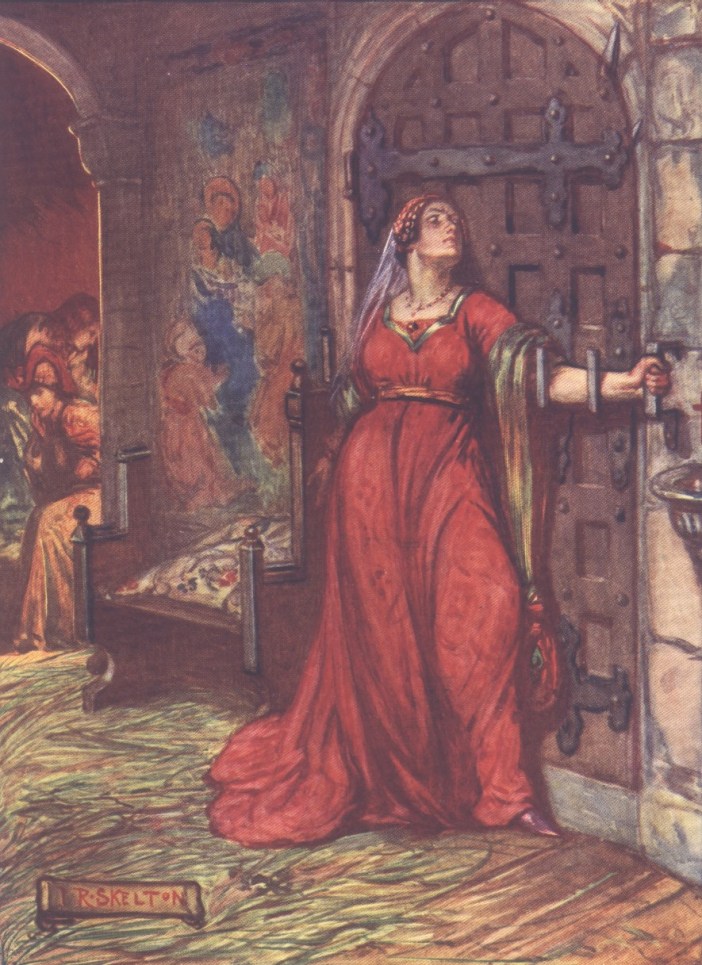
Finding the drawbar had been removed from the door to their chamber the royal couple and their servants began lifting the floorboards to escape into a sewer tunnel. With only seconds to spare as the assassins rushed up the stairs with blades drawn Catherine Douglas braced herself against the door to the chamber and threaded her hand through the iron hoops on the back of the door into the recess in the stonework of the door jamb that received the drawbar, a block of solid wood around 4″ thick. The seconds until her forearm was snapped in two and bent back bought the king enough time to get into the tunnel while the queen and her ladies-in-waiting replaced the floorboards.
Unfortunately, the brave attempt was in vain as the assassins discovered the sewer tunnel beneath the floorboards. The end of the tunnel had recently been blocked to prevent tennis balls getting lost and James I was trapped and killed, being finished off by the blade of Sir Robert Graham. The queen escaped, although wounded, with her lady-in-waiting Catherine Douglas, whose arm was now mangled and would be from then on known by the surname of Barlass. The phrase “Katy, bar the door!” a saying warning of impending trouble is thought to originate from the story of Kate Barlass’ courage.
Prelude to Assassination. A truce between England and Scotland expired as pre-arranged in May 1436. The changing of allegiances between the European kingdoms led to James I renewing the Auld Alliance (the old alliance between France and Scotland). The powerful Duke of Burgundy, who ruled the Low Countries, one of Scotland’s major trade partners, switched his alliance from England to France. France had pressured James to renew the Auld Alliance since 1428, and he had promised a Scottish army to Charles VII of France, and the marriage of his eldest daughter to the Dauphin (the French king’s heir). For political reasons James held off on fulfilling these promises until the Duke of Burgundy joining the French side made them a realistic proposition. With the expiry of the Anglo-Scottish truce in May 1436, James led his army to attack Roxburgh Castle, an English enclave on Scottish soil, while his daughter Princess Margaret sailed to marry the Dauphin. Infighting in the Scottish army’s command weakened the besieging force and it was forced to retreat as the Earl of Northumberland and the Bishops of York and Durham brought their forces across the border to relieve Roxburgh Castle. The chroniclers wrote that the Scottish army “fled wretchedly and ignominiously” and the valuable artillery train was abandoned.
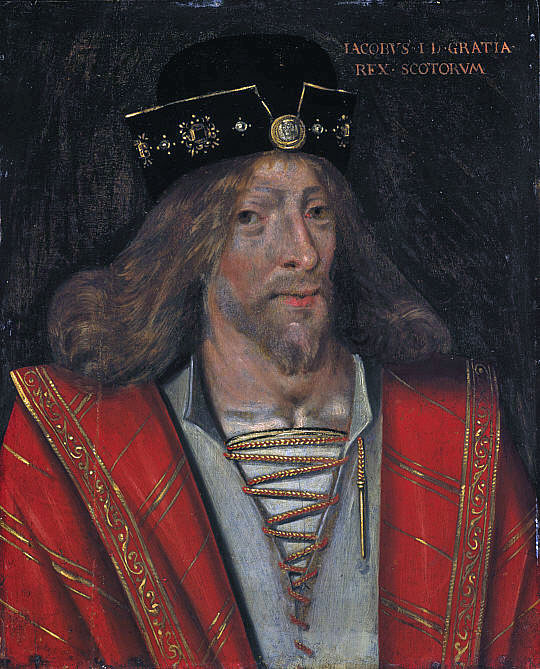
The king’s enemies behind the assassination seized this opportunity to act against him while he was weakened politically and retreating defeated back into Scotland. The three main conspirators against the king were the Earl of Atholl, Walter Stewart; the King’s Chamberlain Robert Stewart (the Earl’s grandson); and Sir Robert Graham of Kinpont. The Earl of Atholl was also a Stewart, and the king’s uncle, being a son of Robert II of Scotland and a half-brother of Robert III.
Strangely, the Earl of Atholl had been a longstanding supporter of the king, being instrumental in ending James’ eighteen year hostage/ransom in England. The Albany Stewarts held the regency of the kingdom between Robert III’s death and James I’s return, and the young James was all that stood between them and the throne. Shortly after his return to Scotland and taking the throne, James, with the Earl of Atholl’s support, executed the Duke of Albany, Murdoch Stewart and his three sons for treason. At a one day trial in Stirling Castle, the four men were linked to the rebellion in the Lennox and immediately beheaded on Heading Hill in front of the castle. The powerful Albany Stewarts were destroyed, their three earldoms and their rents forfeited to the Crown, and the death of James’ older brother David Stewart in Falkland Palace while a captive of the Albany Stewarts was avenged.
The Earl. It is unclear why the Earl of Atholl turned against his nephew the king, after working so hard to return James to the Scottish throne and supporting him against the powerful Albany Stewarts and seeing his own cousin Murdoch Stewart executed. However, in 1582 the Scottish chronicler and historian George Buchanan theorised that the Earl had played out a Littlefinger-like long term plan to free the king and frame the Albany Stewarts for treason so that the two branches of the House of Stewart would destroy each other. With both branches destroyed the Earl would only have to revive the old accusations of illegitimacy against his own half-brother Robert III to open his own path to the throne of Scotland. Both of the Earl’s sons died serving James I, his eldest David died in England in 1434 while one of the hostages for James’ release, and his youngest Alan died fighting in the king’s service at the Battle of Inverlochy in 1431.
Aftermath. The injured queen escaped and joined with her small band of loyal supporters, including the Earl of Angus. Crucially the king’s six-year-old son had already been removed from the custody of John Spens, one of the Earl of Atholl’s associates. One month after the assassination the king’s killers had been captured by the Earl of Angus and the supporters of the queen and her young son.
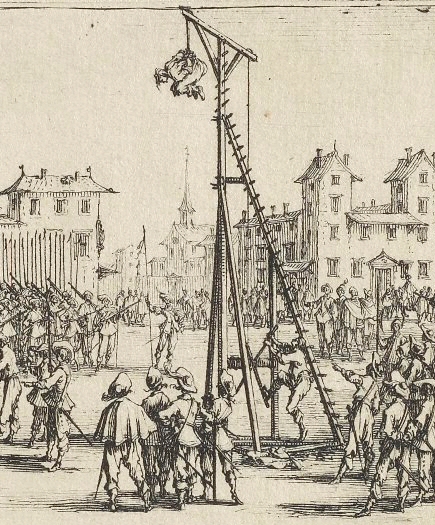
Imprisoned in Edinburgh’s dreaded Tolbooth prison the Earl of Atholl was publicly tortured over three days before his execution. On the first day he was loaded into a cart with a crane where he was hoisted up to a height on the crane, dropped, and then the brakes suddenly applied to the crane, bringing his fall to a violent stop and explosively stretching and snapping his joints. This is the same or very similar to a torture used by the Spanish Inquisition called the Strappado. In the classical example of the Strappado, the victim is lifted by their arms tied behind their back, extending and internally rotating the shoulder joints with the full weight of the body plus the added tension of any attached weights or drops. The Earl was then pilloried and a red hot iron crown with the inscription “King of All Traitors” was placed on his head.
On the second day of the Earl’s torture he was dragged through Edinburgh on a hurdle (a fence panel) to receive the abuse of the capital’s citizens. Some accounts say he was also tortured with red hot pincers and blinded on this day, but the historian George Buchanan (writing in the sixteenth century) mentions only the hurdle. This was also the day that James II was crowned King of Scotland.
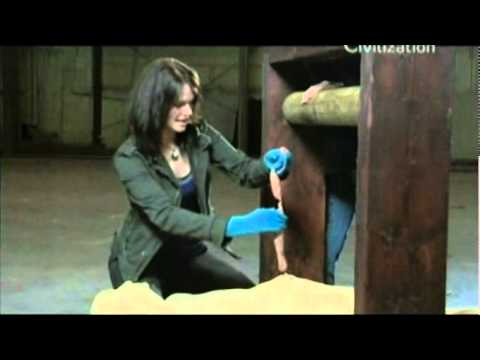
The Earl was executed on the third day by being disembowelled alive, sometimes in the medieval world a windlass-like device was used to pull the intestines out by turning a handle to extract them from the body and wind them around a drum. A skilful executioner would be able to release a length of intestine from the body through only a small incision, increasing the survival time of the victim. In 1535, John Houghton is said to have prayed while being disembowelled. The Strappado and the disembowelling device were both featured on the Discovery Channel experimental archaeology show Machines of Malice, a series which recreated torture and execution machinery and assessed them with medical and scientific experts. It is not known whether the disembowelling device was used on the Earl of Atholl but his extracted bowels were burnt in front of him, if he was still alive at this point he would not survive much longer as his heart was cut out before his body was beheaded and cut into quarters. The heart and bowels were burnt to ashes, but the head and quarters were displayed around the kingdom as a warning to other traitors and as reassurance that justice had been done.
 Archaeology Game of Thrones
You must be logged in to post a comment.