Season 5 episode 8 ‘Hardhome’ makes us ask again, what are the White Walkers? The notion that we could have once shared the earth with another rival group of humanlike but fundamentally different beings seems like pure fantasy today, but the fear of “the others” may once have been reality for our ancestors. Today, modern humans are the only human lineage, but there were many others and sometimes more than one species of the genus Homo (modern humans, archaic humans and earlier Homo species) existed on Earth at the same time.
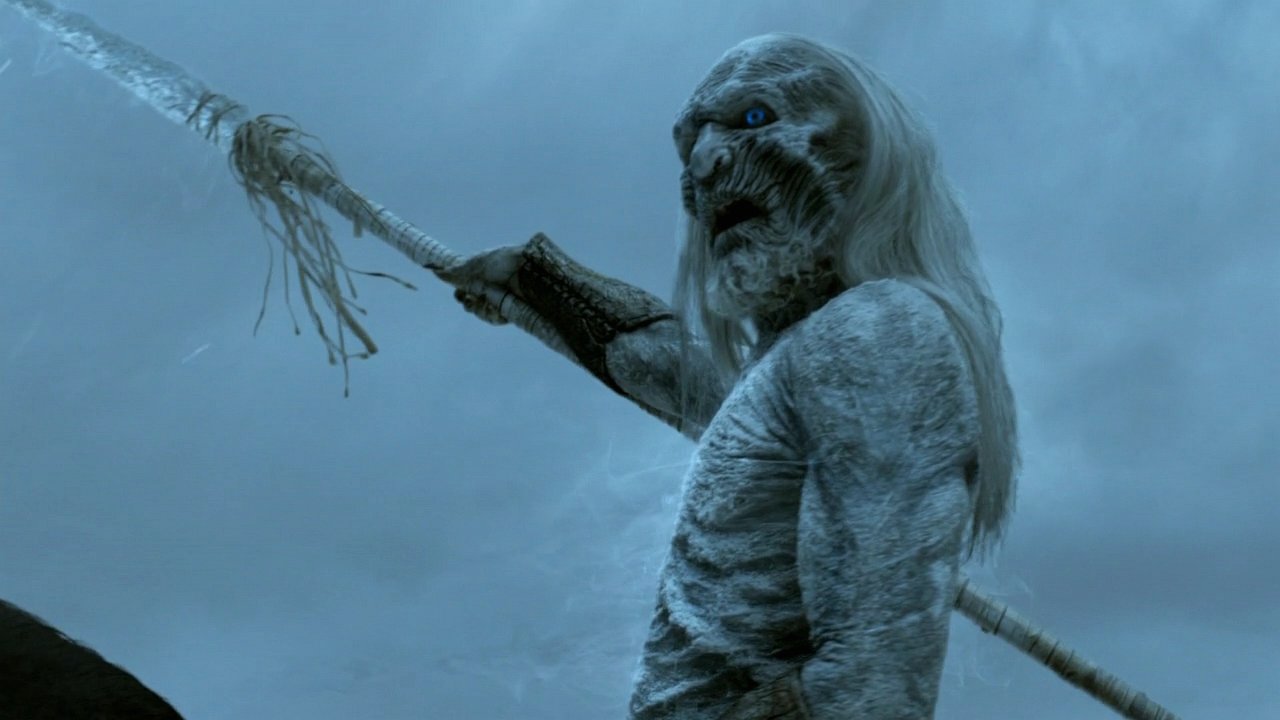
A Long Time Ago… The study of these ancient humans, our evolutionary ancestors and relations, is called paleoanthropology, a discipline that combines archaeology/anthropology, the study of us, (anatomically modern) humans in the past, with palaeontology, the study of fossil lifeforms. Israeli paleoanthropologist Yoel Rak used the Star Wars Bar Theory to banish the idea that we, Homo sapiens, anatomically modern humans (we have been anatomically modern since prehistory, that is just our name as a species), are the sole representative of the genus Homo on Earth. For most of time, there were multiple species of humans and Yoel Rak compares the diversity between them to the variety of alien beings in the Cantina scene on Tattooine in Episode IV. He could have made the same argument using the men, giants, Children of the Forest, dragonlords and White Walkers of the World of Ice and Fire to represent the diversity of ancient humans over time.
The First Men. Paleoanthropology is an area of archaeology that perhaps suffers the most from competing theories, cladistic arguments, and controversies regarding the evidence, of which there is little, and this can be hundreds of thousands of years old. Dating material this old is difficult and imprecise, and the scant remains make it difficult to see the full picture. The Denisovans, another extinct human species in the genus Homo, only survive as a fragment of child’s finger bone and two adult teeth. It was only in 2008 that the Denisovans were first discovered, and the age of their remains cannot be pinpointed any more exactly than between 80,000 and 30,000 years ago. Other human species like the Red Deer Cave People and Homo tsaichangensis are even more recent discoveries (2012 and 2015) and may yet be argued to be members of an already known species, a subspecies, or a hybrid caught partway through evolving from one ancestor into the next.
One of the last extinct ancestors of modern humans are the Neanderthals, who lived in Europe and Asia until they disappeared around 40,000 years ago. For a brief time starting around 50,000 years ago, we (modern humans) shared Eurasia with the Neanderthals as we spread out of Africa, where we had evolved. DNA evidence even suggests we interbred with them, 1.5 to 2.1% of the DNA of anyone with Eurasian ancestors is thought to originate from Neanderthals (although there is a competing explanation that this DNA is simply from a common ancestor). The exact nature of our interaction with the Neanderthals and whether we played a role in their downfall are mysteries that have intrigued archaeologists. We may have gradually outnumbered and outcompeted them over thousands of years as they faded into the background unnoticed, or we may have annihilated them in a campaign of genocide.

They come when it’s cold. Who were the Neanderthals? What did they look like? While there have been great breakthroughs with Neanderthal DNA and genetics in the last ten years, the only Neanderthal remains we have today are bones, nothing we know about Neanderthal soft tissue is a certainty. However, the evidence points to beings of similar height to our prehistoric ancestors, but heavily muscled and much stronger, Neanderthal males averaging 1.64-1.68m, 77.6kg and females 1.52-1.56m, 66.4kg. Like the White Walkers, there is some evidence that the Neanderthals were adapted to cold conditions, in the Levant there are archaeological sites that have been vacated by humans and then taken over by Neanderthals as more cold-adapted animal bones appear alongside them.
There are a lot of healed fractures on Neanderthal skeletons and the closest match to a human injury profile is that seen in modern rodeo riders. This suggests that Neanderthals attacked the large animals they hunted close-up, ambushing them and bringing them down in hand-to-hand combat. It is controversial whether Neanderthals used the projectile weapons that humans employed. While they had spears many scholars think they were only used for thrusting as the different shape of the Neanderthal’s shoulders, massively wide, with long collar bones and short, bowing shoulder blades, meant that the Neanderthals could not throw effectively.

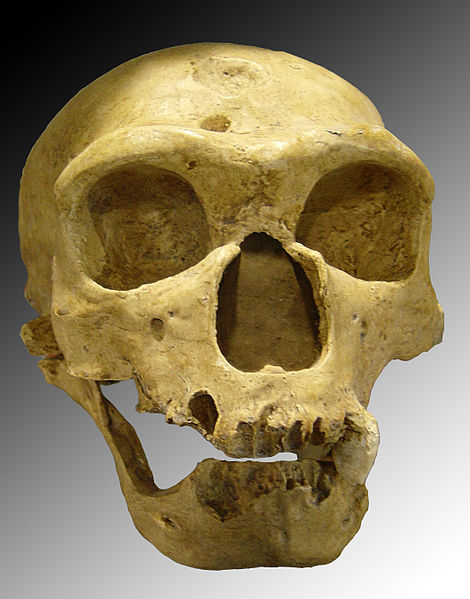
The Neanderthal skull is larger than our skull, taller with a more projecting face, the nose bigger and further forward. It is also longer with a distinctive bun shape at the back of the head, allowing for a larger brain, 1500-1900cm3 of cranial capacity compared to modern man’s 1425cm3. This larger brain does not mean the Neanderthals were cleverer than us, only that their larger bodies needed more neurological controls. Eye sockets are also significantly larger and it is thought that these larger, more effective eyes and their vision processing requirements accounted for more of the large Neanderthal brain. Humans living at high altitude, like the Neanderthals, evolved bigger vision areas in the brain, and with so much of their brain taken up with visual processing and co-ordinating their large muscles this left a smaller cognitive area. There is a theory that this led to the Neanderthals becoming extinct as the way they thought was fundamentally different to ours with a lower capacity for forming large social groups and dealing with change, such as climatic deterioration and competing for resources with humans.
Ultimately, we do not know what happened to the Neanderthals and there are many factors that can contribute to their extinction. But it seems that we may have been to them what the White Walkers are to the Free Folk. While the first anatomically modern humans to come out of Africa did not have the power to raise the dead to fight for them or command packs of ice spiders they did have other powers that would have seemed like magic to the Neanderthals: Domesticated dogs, thought to have been one of the main factors that gave humans the edge over Neanderthals when hunting food. Until 2009, dogs were thought to have been domesticated long after Neanderthals disappeared, but a new statistical technique developed in Belgium allowed archaeologists to separate wolf skulls from dog skulls and showed that dogs had been living with humans since around 32,000 years ago. Research from Japan shows that humans are the only living primates to have visible white sclerae, the whites of our eyes. Evolving this trait may have helped us domesticate dogs, as the white sclerae make it possible for them to be able to nonverbally tell what we are looking at, something dogs are good at. Unfortunately, there is no confirmation yet from genetic studies that Neanderthals did not have white sclerae.

Children of the Forest. It is not only the White Walkers who have parallels in our remote past, the Children of the Forest can be compared to Homo floresiensis. Since 2003, the partial skeletons of nine individuals have been recovered from the island of Flores, Indonesia. Standing only about 1.1m tall when fully grown they are referred to as Flores Man, or hobbits, due to their short stature and distinctively long, flat feet. With a body mass estimated to be only 25kg (55lb) Homo floresiensis is the shortest and lightest ancient human. The limited food environment on Flores is thought to have made Homo erectus who found their way onto the island evolve into the smaller Homo floresiensis in order to survive, a process known as island dwarfism.
Discovering archaeologist Mike Morwood and his team decided that Flores Man was a new species in the Homo genus, and proposed that they had lived on Flores alongside anatomically modern humans. Several opponents have come forward claiming that the remains are not a distinct species, but that they are humans with Laron syndrome or endemic cretinism, or that LB1, the type specimen (the first set of remains found) has Down syndrome or microcephaly. These arguments have been countered and it is now generally accepted that Flores Man is a distinct species.
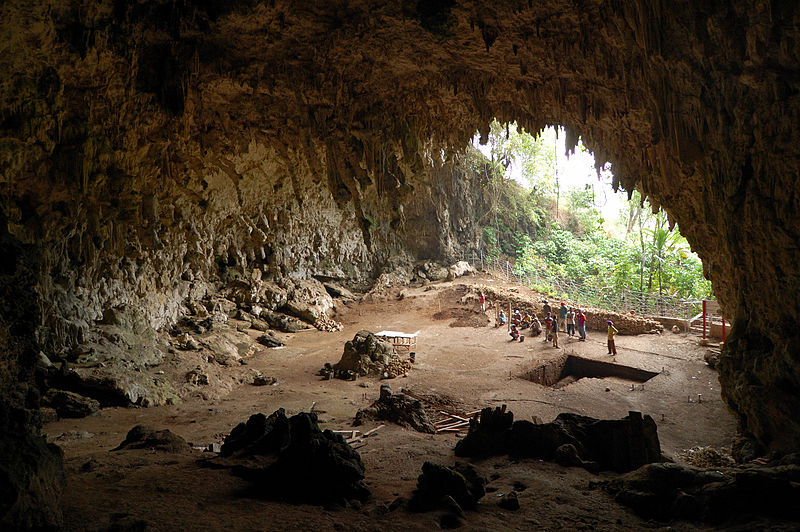
The Flores Man skeletons were found in a cave known as Liang Bua, which bears some resemblance to the cave seen in season 4 when Bran meets the Children of the Forest for the first time. In the cave is evidence that the Flores Man had fire to cook with, their own miniature sized stone tools, not unlike those the Children made from dragonglass, and the bones of Stegodon, a prehistoric elephant they apparently managed to hunt despite their small size. Several species of Stegodon existed on prehistoric Flores and seem to have evolved into dwarf forms like Flores Man. The Stegodon sondaari dwarf species died out around 850,000 years ago, then the normal sized Stegodon florensis arrived, probably swimming from another island during low sea levels, and shrank to become Stegodon florensis insularis.

Like the Valyrians, and other ancient human species, the extinction of Homo floresiensis is thought to have been brought about by a volcanic eruption around 12,000 years ago. However in the folklore of Flores is a creature that strongly resembles Homo floresiensis, the Ebu Gogo, ‘grandmother who eats anything’ in the Nage language. Not much more than a metre tall, hairy, with broad faces, large mouths and wide, flat noses the Ebu Gogo walked upright and could even run fast, they were said to mumble in their own language and could repeat what humans said to them. The Nage people believe that the Ebu Gogo were still alive when the Portugese arrived in the 16th century but began to be hunted to extinction in the 18th century to stop them stealing food and human children. These folklore stories hold that the Ebu Gogo kidnapped human children in the hope of learning how to cook food from them.


 Archaeology Game of Thrones
You must be logged in to post a comment.